Popular Cinema and Politics in South India by S. Rajanayagam
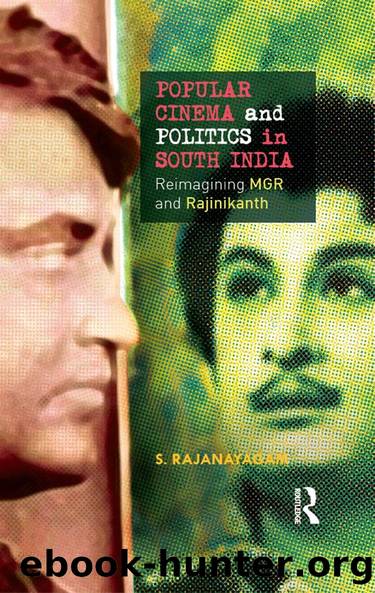
Author:S. Rajanayagam [Rajanayagam, S.]
Language: eng
Format: epub
Tags: Social Science, Media Studies, Performing Arts, Film, General, Political Science
ISBN: 9781317587729
Google: eVLeCQAAQBAJ
Publisher: Routledge
Published: 2015-06-12T05:59:05+00:00
The âAnnaâ DMK Phase
By the time of the split in the DMK, MGR had firmly established himself as the most acceptable alternative to the then DMK leadership by metalepticaly overlapping the screen, private and public realms. The Anna whom he tried to replace during the first phase and to appropriate and own during the second phase is now ceremoniously re-placed as the figure-head of his party, the Anna Thiraavida Munnaetra Kazhakam. The naming of his party formed in October 1972 as Anna DMK (meaning, the DMK of Anna) amounts to saying that the âDMKâ led by MGR is the âoriginalâ DMK founded by Anna, as distinct from the DMK now headed by Karunanidhi. The message thus communicated is that the ADMK is not a new party different from the one founded by Anna, but the same party founded by him, only now liberated from Karunanidhiâs illegal possession. MGRâs political genius, outwitting all others including Anna, is evident in the way he had engineered the smooth, logically consistent and emotionally convincing metamorphosis of the proto-ADMK (phase-1) to parallel-DMK (phase-2) to Anna-DMK. In a striking correspondence, once MGR was dismissed from the DMK, he constantly referred to the DMK only as âKarunanidhi katchiâ (Karunanidhiâs party).11
The spontaneous response of the fans of MGR to the dismissal was violent and posed a serious threat to the law and order. In cities like Madurai, even the State machinery was paralysed for a while. The Karunanidhi government came down heavily on the followers of MGR and repressed the agitations. The days that followed witnessed more organised processions, rallies and public meetings. It is during these days of agitations MGRâs own production Ulagam Sutrum Vaalipan was released (May 1973) after a protracted struggle to mobilise sufficient financial resources to produce. The DMK men expected severe criticism of their party in the film and were prepared to disrupt the screenings. A schemer as he was, MGR disappointed them all by ignoring to play their style of politics. Except for a moral or two â âYou should live laughing but donât live in a manner where others laugh at youâ¦â â which might be construed as a mild criticism of Karunanidhi, the film did not reflect the sensational politics of the day. He played his own political cards instead. His was the âpolitics of winning by failing to fulfil the expectationsâ of the foes. With foresight, he addresses cultural-psychologically rooted and politically significant issues.
First, he refutes the allegation that he is aged â therefore, by implication, too old to be popular â by touring around the world in double roles with four young girls. As one of the girls sings, he is the vaalipan (young man) âof golden colour, childâs heart, munificent characterâ, âthe divine son who comes as the kingâ. While the âvaalipanâ MGR feasted the fantasy of women viewers, the âgenerous exposureâ of the heroines satisfied the male voyeurs. Naturally, the film was a super-hit. Second, he puts a definite full-stop to the controversy over his origins.
Download
This site does not store any files on its server. We only index and link to content provided by other sites. Please contact the content providers to delete copyright contents if any and email us, we'll remove relevant links or contents immediately.
| Anthropology | Archaeology |
| Philosophy | Politics & Government |
| Social Sciences | Sociology |
| Women's Studies |
Cecilia; Or, Memoirs of an Heiress — Volume 1 by Fanny Burney(32562)
The Great Music City by Andrea Baker(32022)
Cecilia; Or, Memoirs of an Heiress — Volume 2 by Fanny Burney(31959)
Cecilia; Or, Memoirs of an Heiress — Volume 3 by Fanny Burney(31945)
We're Going to Need More Wine by Gabrielle Union(19052)
All the Missing Girls by Megan Miranda(16048)
Pimp by Iceberg Slim(14520)
For the Love of Europe by Rick Steves(14162)
Bombshells: Glamour Girls of a Lifetime by Sullivan Steve(14081)
Norse Mythology by Gaiman Neil(13376)
Talking to Strangers by Malcolm Gladwell(13376)
Fifty Shades Freed by E L James(13247)
Mindhunter: Inside the FBI's Elite Serial Crime Unit by John E. Douglas & Mark Olshaker(9347)
Crazy Rich Asians by Kevin Kwan(9297)
The Lost Art of Listening by Michael P. Nichols(7508)
Enlightenment Now: The Case for Reason, Science, Humanism, and Progress by Steven Pinker(7316)
The Four Agreements by Don Miguel Ruiz(6770)
Bad Blood by John Carreyrou(6626)
Weapons of Math Destruction by Cathy O'Neil(6284)
